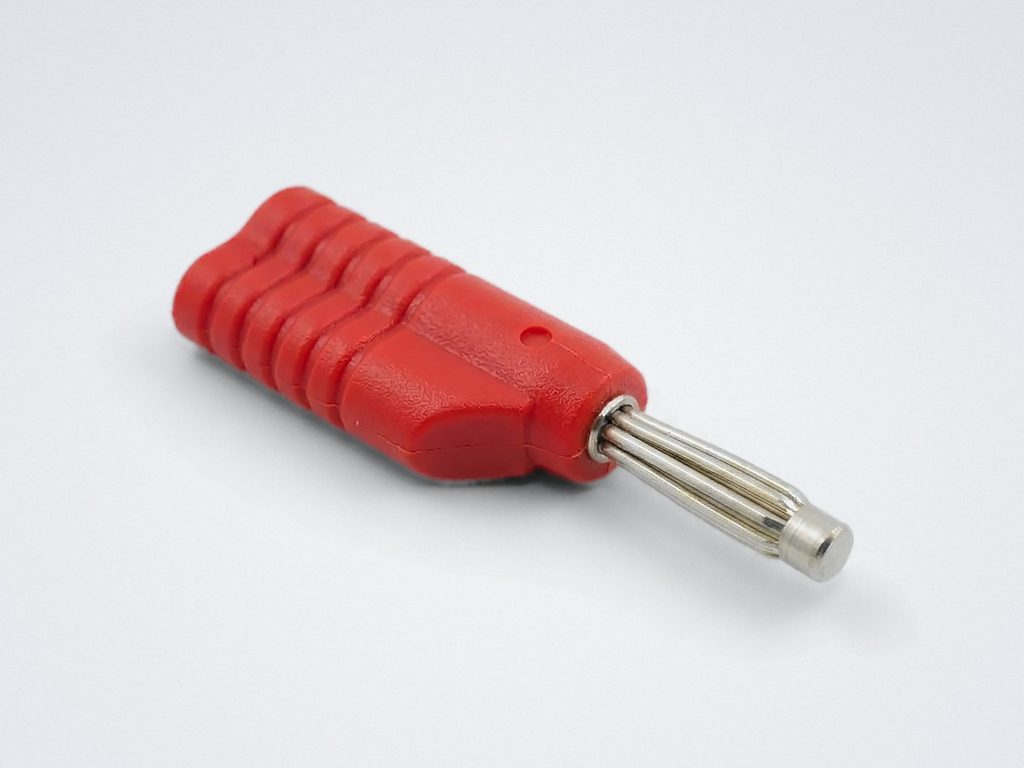
4 mm system
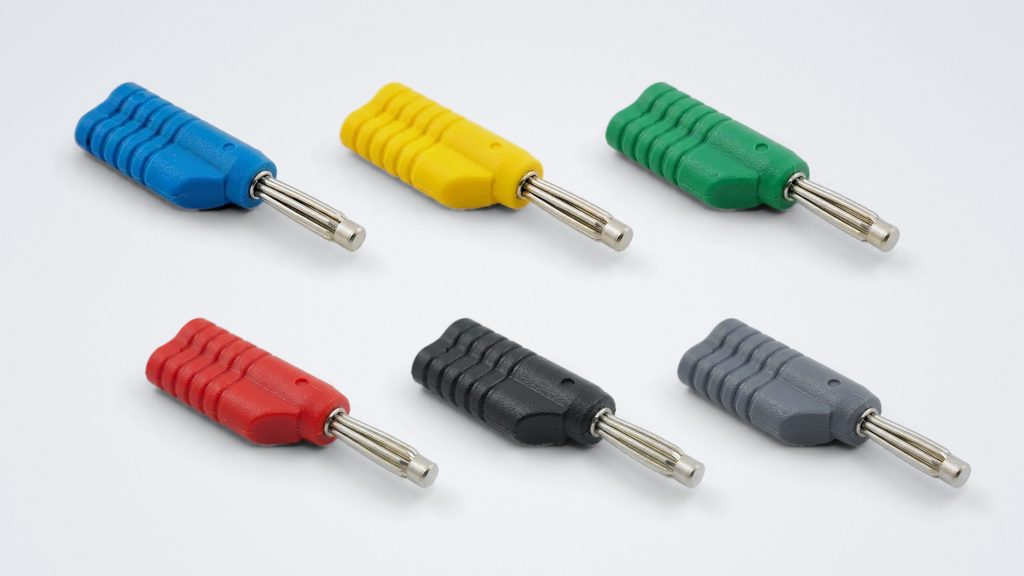
4 mm bundle-wire and spring-basket plugs from the catalogue, with marking, printing and cable to your specification.

It all comes down to the right connection
Every contact point adds resistance. So Schnepp splits the current over many parallel contact points: connector contact technology from the bundle-wire banana plug to the custom high-current contact.
01 Principle
Every electrical contact point adds resistance, mainly constriction resistance and film resistance. Both turn into power loss and heat. They limit the current a connection can carry, or they disturb signal transmission. How the contact points are sized and designed therefore decides whether a system works, and for how long.
All Schnepp contact technologies rest on one physical principle: resistances in parallel. The current splits over many paths. In Schnepp products the single contact resistances can be taken as equal, so the total resistance falls to one n-th of a single contact, while the permissible current rises to n times the capacity of one contact point.
What you get is maximum reliability from redundant contacts, combined with maximum current capacity from parallel current paths. Our engineers adapt each of these designs to your application.
Total resistance
13 %
of one contact point
Permissible current
8 ×
of one contact point
If one point fails
+14 %
more total resistance
With a single contact point the connection is broken.
Schematic based on the law for resistances in parallel. All values relative to a single contact point, not product data.
02 In section
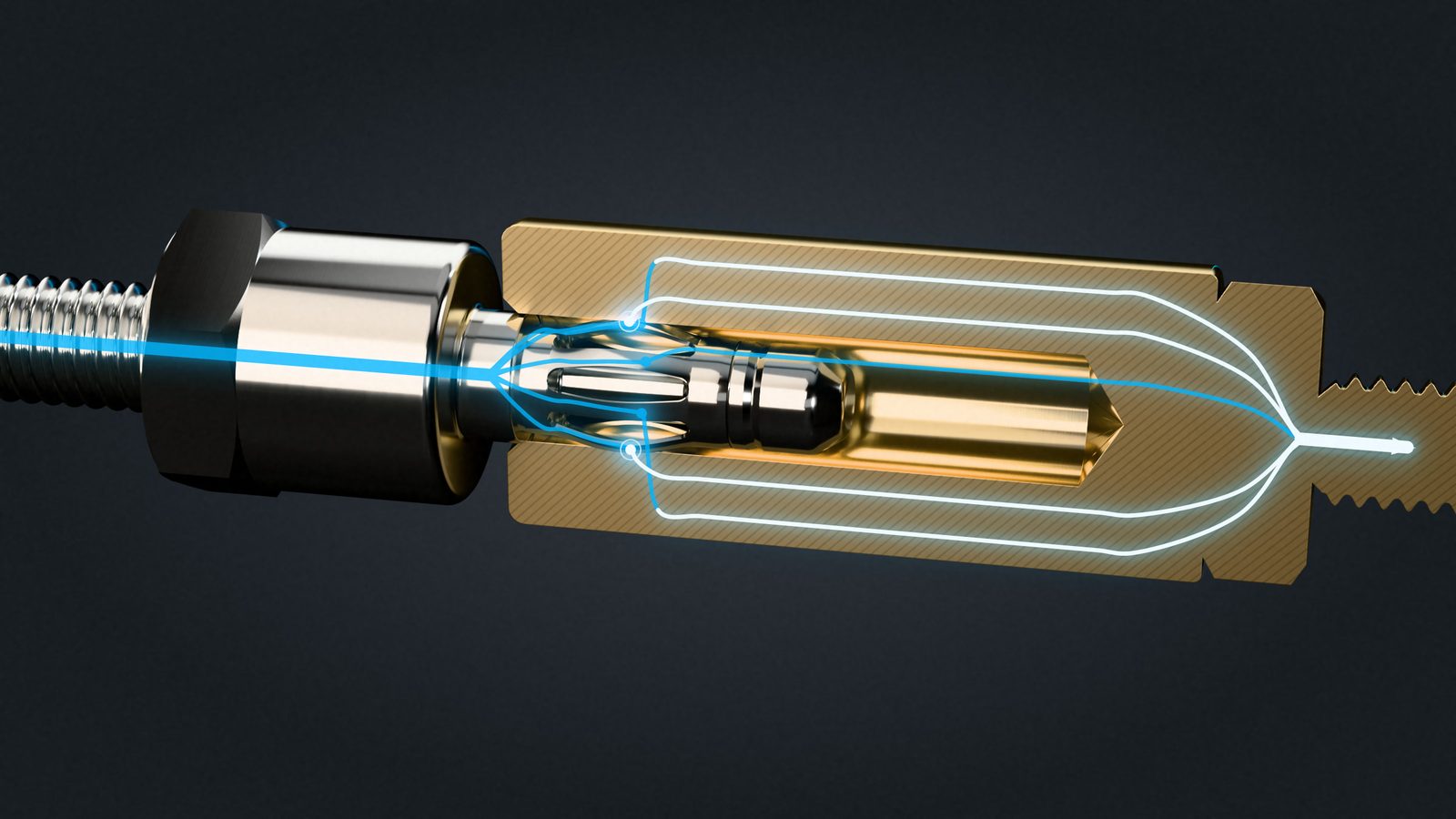
A 4 mm bundle-wire plug in its socket, cut open: this is the path the current takes from the cable connection into the socket.

The current enters the plug body through the cable connection. Up to here it flows along a single path.
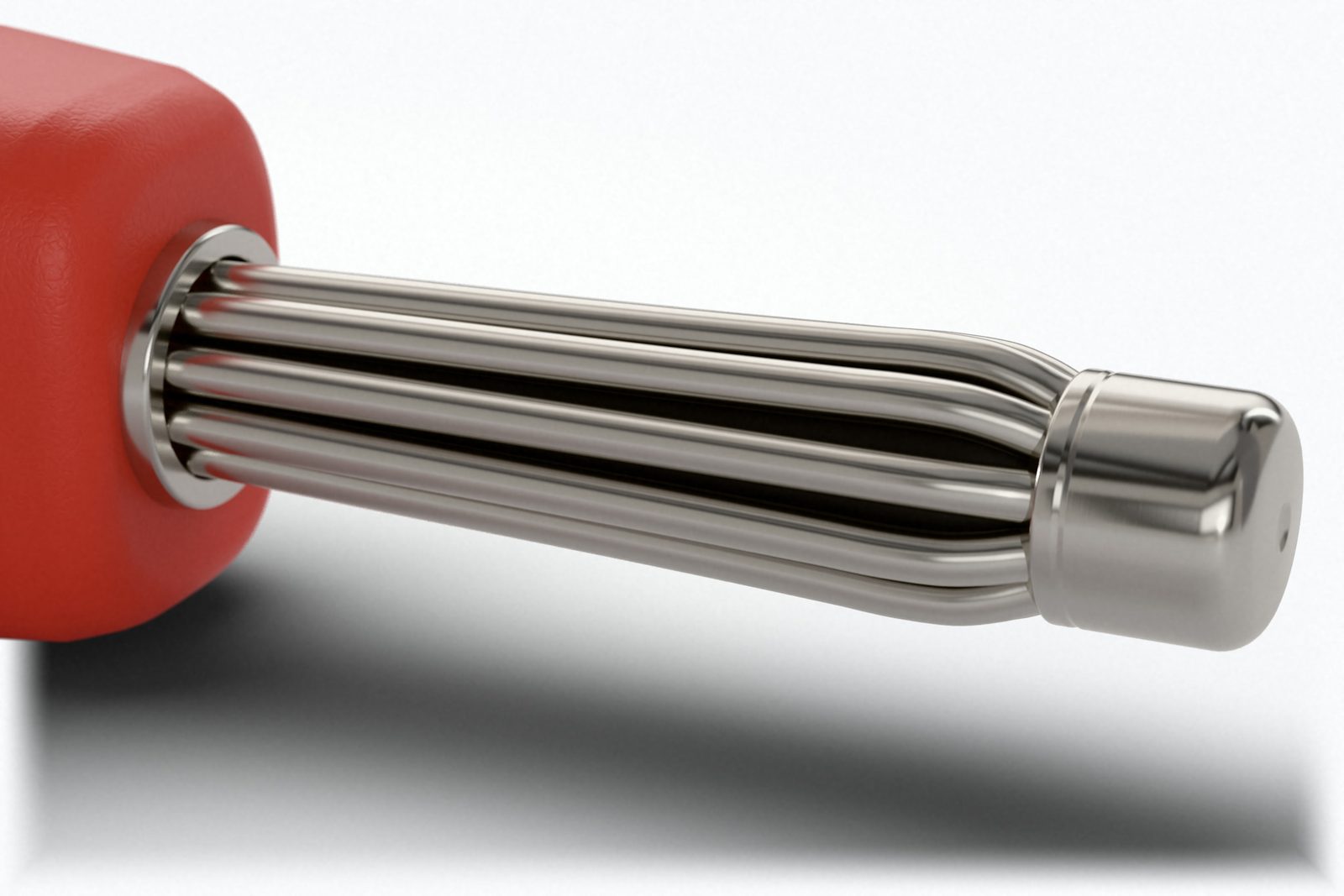
In the bundle it splits over the pressed-in spring wires. Each wire makes its own contact with the socket and carries a small share. The contact points work in parallel: if one fails, the others take over.
In the socket the partial currents merge again and leave the connection through the terminal.
03 Spring-wire technology
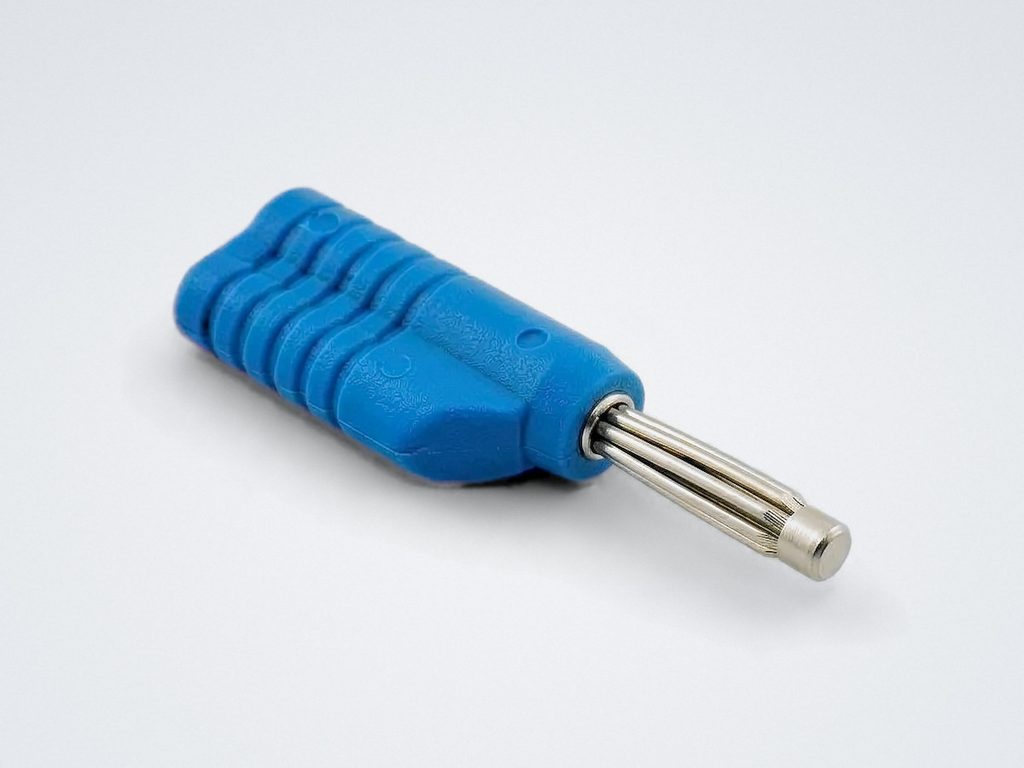
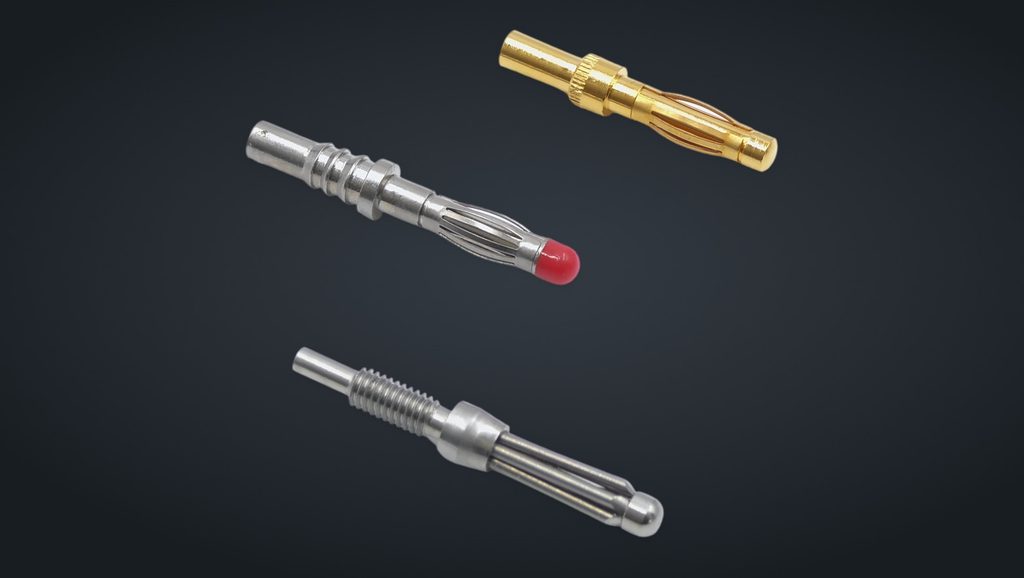
A Schnepp bundle-wire plug is made of many pressed-in spring wires. The wire stock combines excellent spring properties with good electrical conductivity. Every spring wire forms an independent contact point with the mating contact and carries its share of the current.
Bundle-wire plugs carry very high currents and feel pleasantly smooth to plug in. For corrosive environments we also use stainless, acid-resistant spring steels.
The bundle-wire plug was among Schnepp's very first products: we have made connectors since the 1950s and bundle-wire plugs with a protective cap since 1960.
04 Spring-basket technology
In a spring-basket plug, also called a contact lamella plug, the pin carries a spring basket of high-grade copper beryllium, a contact lamella of the leaf-spring type. Its sprung segments touch the socket at many points at once: many redundant contact points, a high current capacity and a low contact resistance.
Spring-basket plugs have been in the range from the very beginning. The catalogue has them from the 2 mm to the 6 mm system, and to your drawing we build them in any size from 2 mm up to high-current connectors. A contact lamella such as the spring basket can also be fitted into a socket: as a sprung socket for a cylindrical pin.
05 Machined contacts
For the smallest applications and the tightest spaces we make plug contacts as slotted round contacts. We choose the material for each task from its geometric, electrical and thermal boundary conditions.
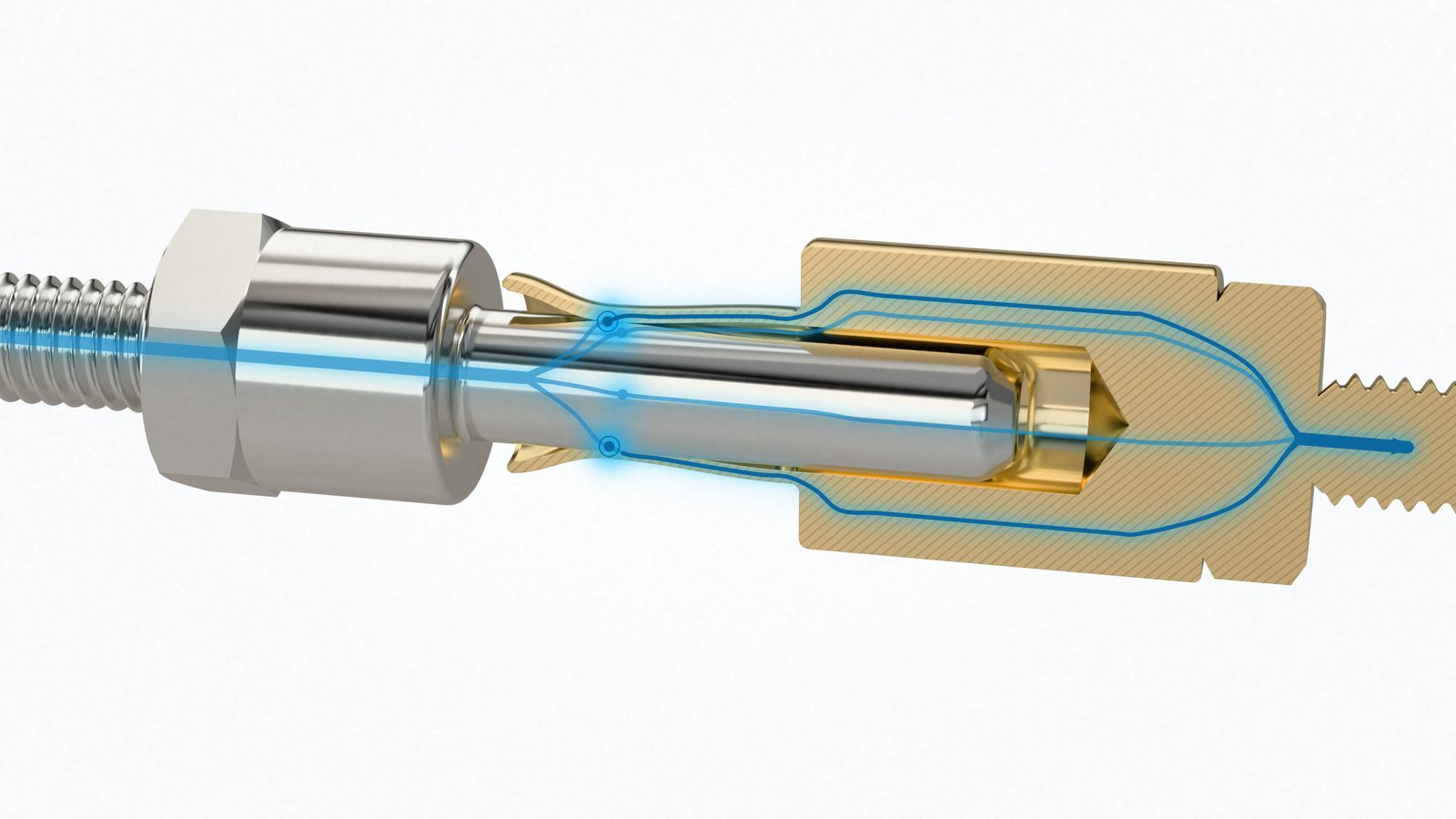
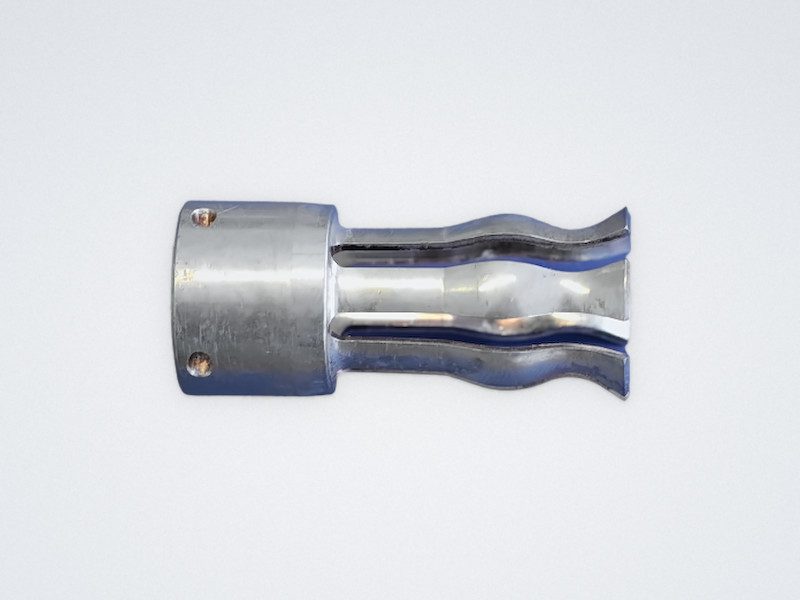
The socket contact is one piece: the socket itself is slotted and its spring fingers contact the pin directly. There is no extra part inside. Machining ensures an optimum contact geometry. We also make special solutions for rotating contacts and contacts that move through an angle.
06 3D side by side


Your browser cannot display 3D graphics. The drawings show the same contact elements.
Illustration. Geometry and number of contact elements are not binding.
07 Overview
| Property | Bundle-wire contact | Spring basket (leaf-spring lamella) | Slotted round contact |
|---|---|---|---|
| Contact principle | many pressed-in spring wires, each one a contact point | copper beryllium spring basket, many redundant contact points | one-piece slotted socket contact with several independent spring fingers that contact the pin directly |
| Mating feel and life | very pleasant and smooth | robust, many mating cycles | depends on design |
| Tolerance compensation | insensitive to tolerances | depends on design | depends on design |
| Size range | 2.4 and 4 mm, mega bundle up to Ø 10 mm | any size from 2 mm upwards | any size from 1 mm upwards |
| Typical use | high current, with stainless spring wires also corrosive environments | banana plugs, high-current connectors to drawing, also fitted into sockets | tightest spaces, rotating or angularly moving contacts |
08 Materials and finishes
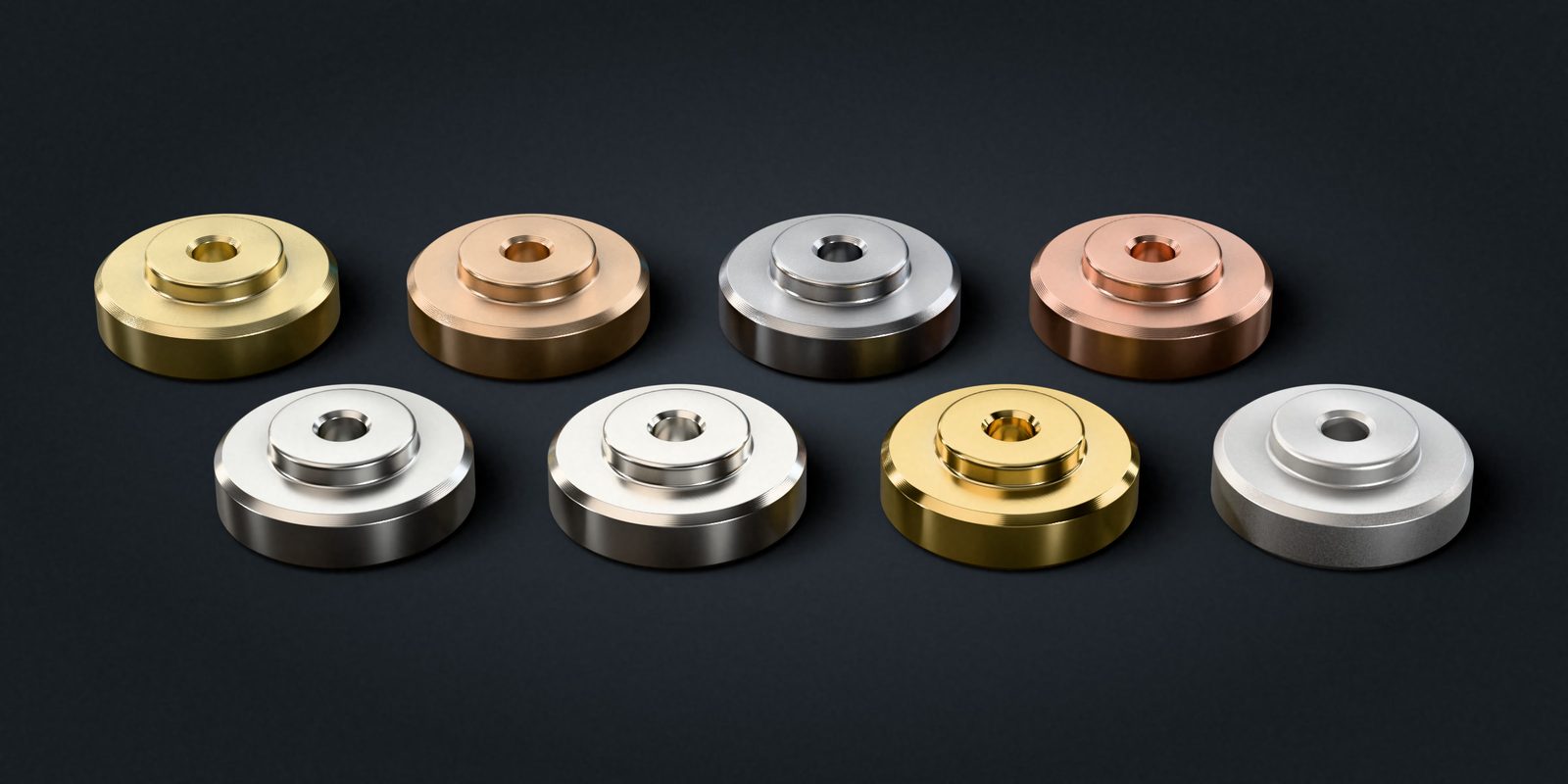
We choose base material and finish for both function and economy: brass, also lead-free, copper beryllium, copper and stainless steel, plated mostly with nickel, gold or silver.
09 Next
4 mm bundle-wire and spring-basket plugs from the catalogue, with marking, printing and cable to your specification.
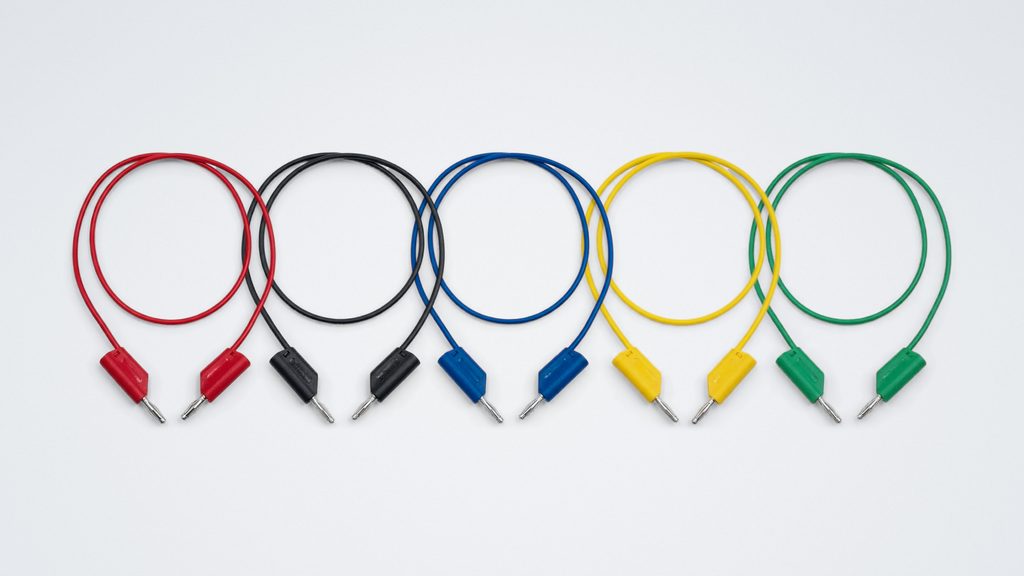
Test leads with bundle-wire or spring-basket plugs, in your length, with your print and the right plug on each end.
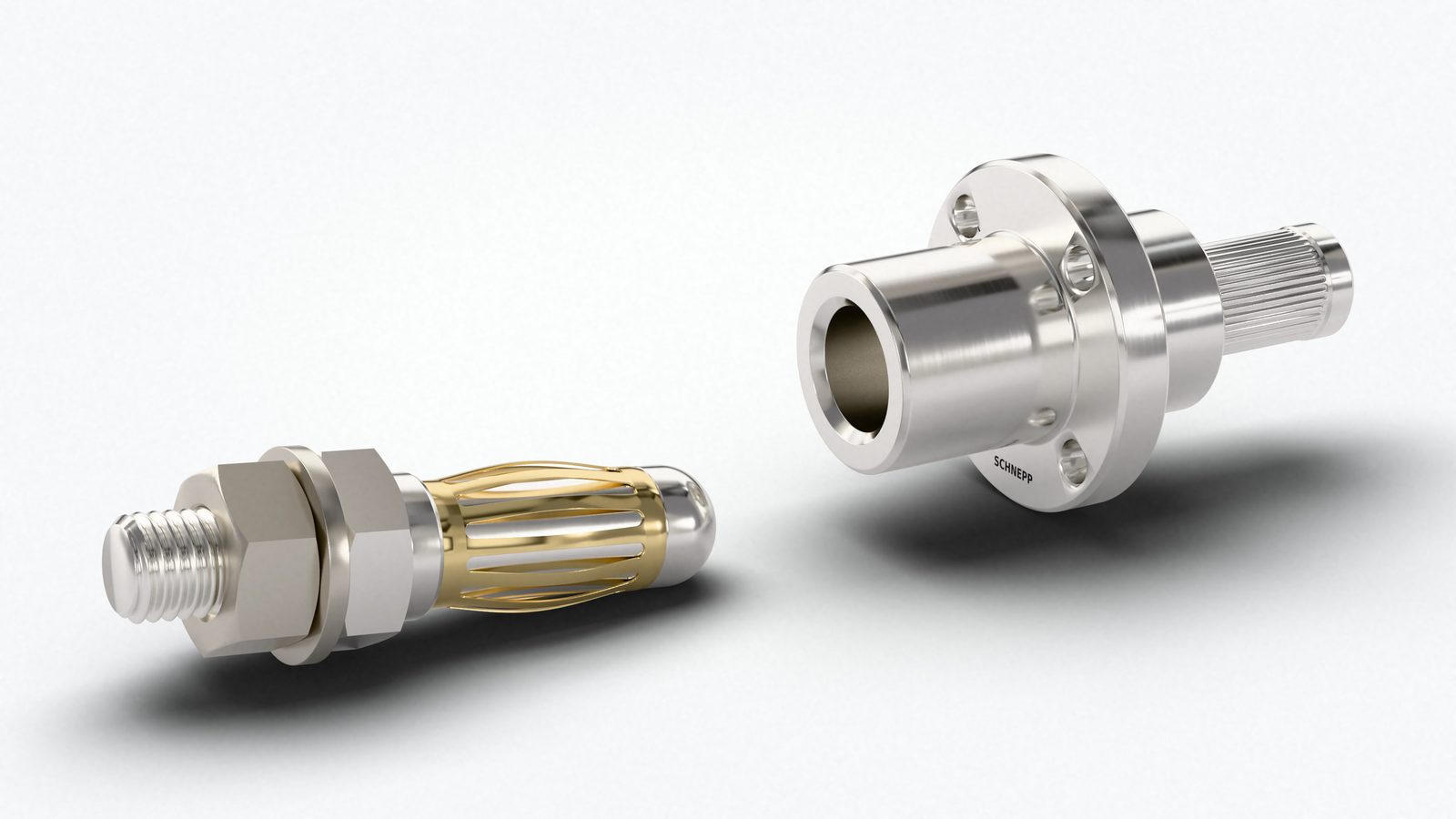
Plugs, sockets and contact pins to your drawing, built on bundle-wire and spring-basket technology.

Work out current and contact points and find matching articles.
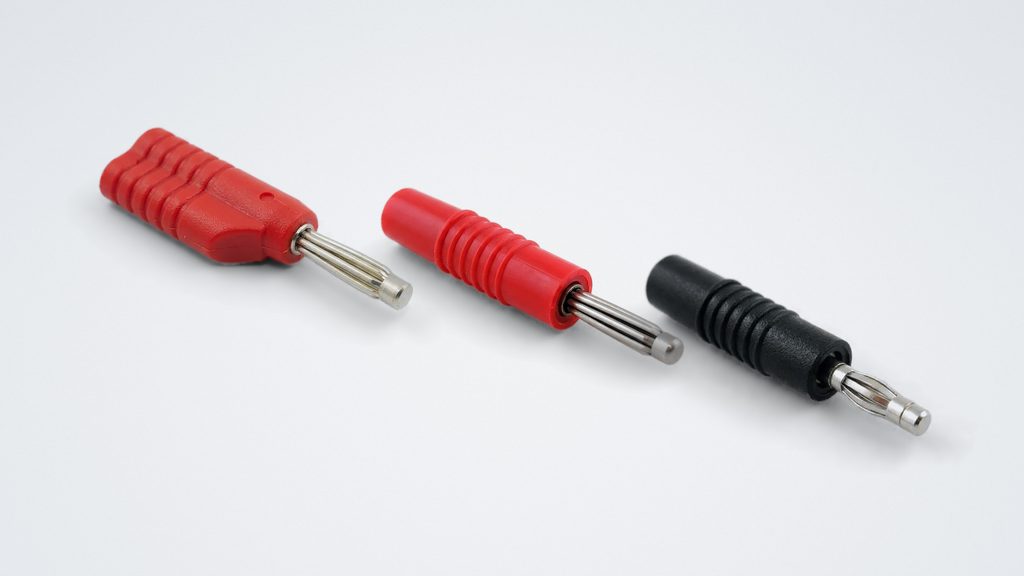
Bundle-wire or spring-basket: the comparison for your choice.
Customisation
We make our standard products with your marking, your name or logo printed on them, in the cable length you need or with a special cable to your specification. And when the catalogue is not enough, we build your own connector.
To your system, so every part is identified at a glance.
Your name or logo printed on.
Test leads in exactly the length your application needs.
A cable to your specification instead of the standard one.
Plugs, sockets and contact pins to your drawing, built on our bundle-wire and spring-basket technology.
From small batches to volume production, made in Neudenau, Germany.
FAQ
Because the current flows through many contact points in parallel. With n equal contact points, the total resistance falls to one n-th of a single contact and the permissible current rises to n times that of one contact point.
A contact made of many pressed-in spring wires. Each wire forms its own contact point with the mating contact and carries part of the current. The result is a high current capacity and a smooth, pleasant mating feel.
The bundle-wire contacts of our bundle-wire plugs, turned parts on automatic lathes, plastic parts by injection moulding, assembly and cable assembly. More under manufacturing.
Yes, one particular type: the spring basket is a contact lamella of the leaf-spring type, also called a leaf-spring lamella or leaf-spring contact strip. Its copper beryllium segments touch the mating contact at many points at once. On the pin it makes the spring-basket plug. Fitted into a socket, a contact lamella such as the spring basket makes a sprung socket, a contact lamella socket. Schnepp does not make the spring basket itself. We fit it into our plugs and choose the right version for your application.
Yes. We build custom connectors to your drawing, up to high-current applications. Send us your drawing or describe your application in the enquiry assistant.
Technical advice
Tell us the current, the space and the environment of your application, with a sketch or drawing if you have one. We pick the contact technology that fits and build your plug and its matching socket on it.